

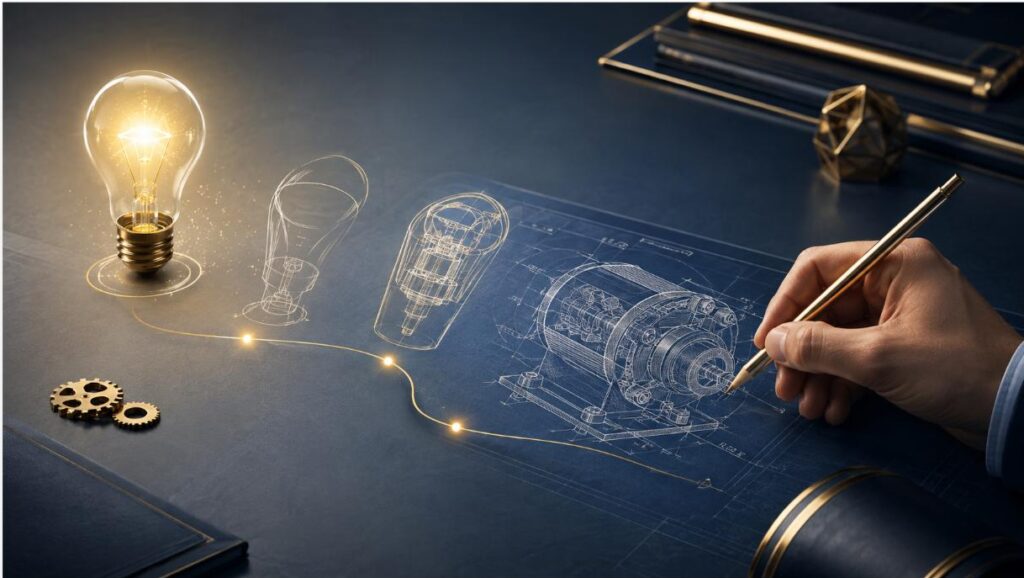
The Patents Law states that a patent can be granted for an invention. Therefore, when an inventor has an idea, our team supports the inventor from the stage of turning the idea into an invention. Defining the invention and the technical path that is protected requires knowledge and experience.
Sometimes inventors come to us with ideas that they were told cannot be protected, because they contain no invention, or because they were found in various information searches and seemingly already exist. Our team holds a brainstorming meeting together with the inventor, and in many cases we find possible solutions for protecting the intellectual property.
Sometimes we use technical consultants who accompany the brainstorming meetings and help the inventor, already from the conceptual stage, to solve technical problems, and the legal team helps with the legal definition of the invention.
It is important to combine legal advice with a technical team, since patent applications are protection for technical products and processes, and therefore we integrate technical consultants into our work.
The Legal Definition of the Invention and the Technical Information
In order to obtain a patent, we need to file an application that contains enough technical details for an average person skilled in the field to understand how the invention can be carried out. Therefore, sometimes when inventors come to us with a general idea or the beginning of an invention, we support the inventor up to the stage of the legal definition, in combination with the technical consultants.
Our firm has a team that prepares drawings for the patent or design application, in accordance with the instructions and regulations of the patent offices or the international examining authorities.
Sometimes there are applicants who do not receive legal advice on how to protect the invention and its technical aspect, and file drawings that are rejected by the patent authorities because they do not meet the conditions of the law and regulations.
For example, we have already encountered applicants who filed color drawings that were rejected, or who filed drawings with a font size that did not comply with the regulations, or who filed markings that did not comply with the regulations.
The patent authorities are strict, even about the top and side margins, and if the team drawing the invention does not have the correct legal guidance, it is likely that drawings contrary to the rules will not be accepted.
Our firm provides drawings for the various applications in accordance with the rules customary in each country, which sometimes vary between different types of applications. For example, in international applications the markings and rules differ compared to applications entering the national phase, for example in the USA.
We believe that a patent or design application should be accompanied by high quality, clear drawings that the examiner will understand. When we detail the invention with high quality 3D drawings, in different views and different sections, in our experience, the clearer the drawing is to the examiner, the easier it will be to obtain a registered patent.
Therefore, we employ high level technical consultants and draftsmen who support the technical aspect, so that we can provide a legal definition that is as broad as possible, with technical and legal alternatives that are as broad as possible, in order to maximize the scope of protection.
For more details, call: +972-3-9711013.